

Cornwall's Royal Raven
Who was Bran, the slain prince named in memorial on one of Cornwall’s best known standing stones?

Mention Bran alongside ravens and most people will think of the youngest Stark son in Game of Thrones. GRRM, like most writers, dig around in ancient history and reworks old, misshapen pieces into something new.
This piece isn’t about an inquisitive boy who had the misfortune to be pushed out of a window after seeing the Lannister brother and sister humping. Instead, it will explore a 5th-century Cornish man who went by the same name, and the Celtic mythology surrounding Bran the Blessed. So if you like talking heads (a real talking head, not the band), then keep reading.
Cornwall’s Ancient Trackways
Our journey begins on The Tinners Way in West Cornwall. This trackway most definitely dates to the Bronze Age and potentially further, to Neolithic times. Countless feet have plodded this route, as I add mine at a spot between Zennor and St Just.
Mên-An-Tol
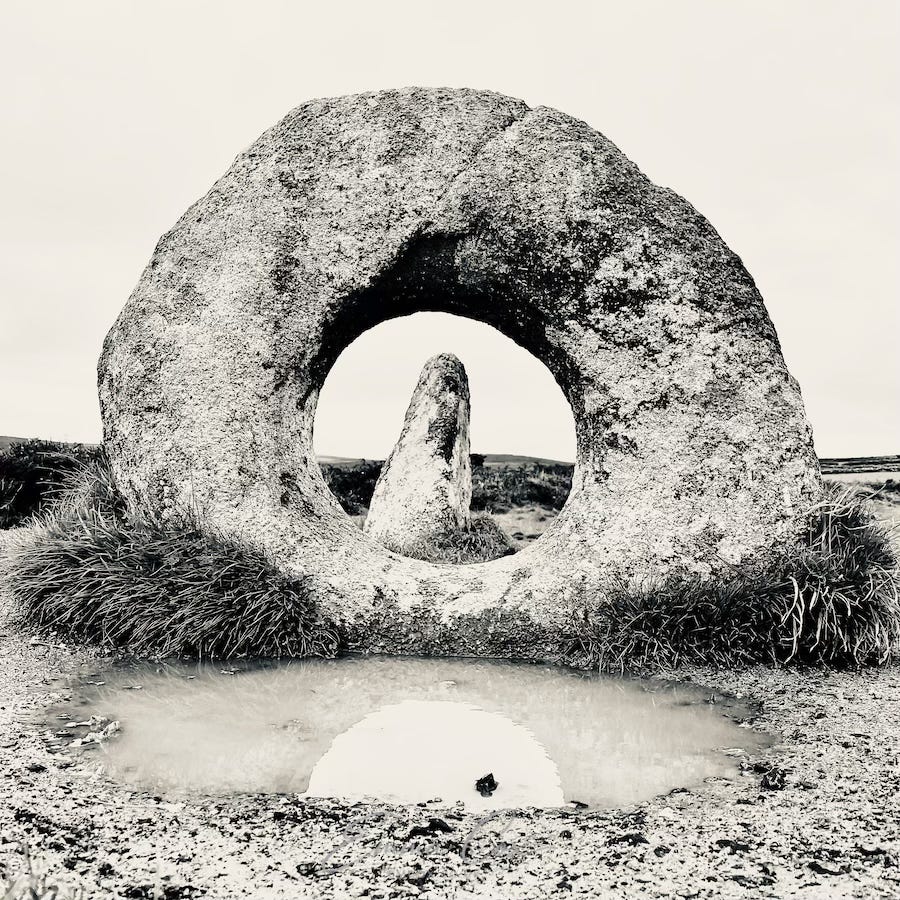
Most walk this route to visit Mên-An-Tol. A curious Bronze Age site because it includes a round granite stone with a man-made hole positioned between two upright standing stones.
Unfortunately, the layout we currently see is the work of Victorians doing the equivalent of a bad touch-up on an old painting. The site was probably a stone circle or chamber tomb, but the original layout has disappeared, and the stones have been repurposed by people over the millennia.
I digress and resume my walk on the ancient trackway to the real reason I’m here: Mên Scryfa. The ‘Mên’ here is Cornish for ‘stone’. While Mên-An-Tol means ‘the stone with a hole’, Mên Scryfa means ‘the stone with writing’. The etymology of place names always interests me because, despite how evocative they can sound, the meaning boils down to ‘say what you see’.
Mên Scryfa
Mên Scryfa is a Bronze Age standing stone with some intriguing 5th or 6th-century graffiti. In Latinised Cornish, we can still make out the words ‘RIALOBRANI CVNOVALI FILI’ (the FILI part now lies below the surface).
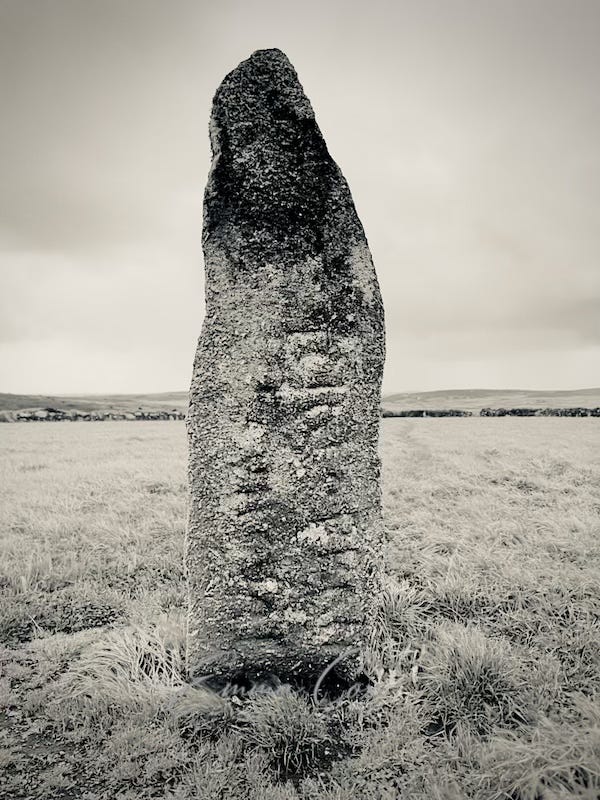
Have you spotted Bran yet?
The inscription translates to ‘Royal Raven, son of the famous leader.’
Ah, so GRRM having Bran in his books interact with a raven makes sense because Bran means ‘raven’. What we have here is a Bronze Age standing stone repurposed as a late Iron Age memorial stone. From the fragmented historical remains and folklore, we are left with a monument and the story of a prince slain while defending his land from unscrupulous interlopers.
Who was Rialobran?
Rialobran was supposedly a member of a local royal family whose home was captured by unscrupulous interlopers. The family fled into exile. However, Rialobran, being nine feet tall (a common embellishment in standing stone stories commemorating an individual is that the stone was an accurate depiction of the person’s height), recruited an army and returned in an attempt to reclaim his homeland. A great battle was fought, and much blood was spilt. With both sides evenly matched and no clear winner materialising, Rialobran and his enemy warlord fought in single combat. This proved fatal for Rialobran, who was slain, and his body was buried by his grieving troops before they departed, leaving the stone as a burial marker for their leader. But since the standing stone is an older relic, perhaps Rialobran copied Cú Chulainn from Irish Mythology and chained himself to the standing stone, despite being mortally wounded, and fought to the end?
Where did the Royal Raven gain his name? Now it’s time to dive into some mythology.
Bran the Blessed
In case you misread that, we’re not talking about the actor, Brian Blessed. In Welsh mythology, Bran the Blessed was both a giant and the king of Britain.
Matholwch, an Irish king, visits Bran to ask for his sister Branwen’s hand in marriage. Bran agrees, but celebrations turn sour when Bran’s half-brother, Efnysien (who comes across as a violent crossover of Don from Sexy Beast and Begbie from Trainspotting), is enraged that Matholwch didn’t ask for his approval. Efnysien decides to mutilate the Irish King’s horses. Bran offers Matholwch a magical cauldron as compensation, which can restore the dead to life (which seems a bit of an excessive gift, but hey…).
Things settle. Branwen and Matholwch have a son named Gwern. However, Efnysien’s insult rears its ugly head. Matholwch’s advisors convince him to banish his wife to the kitchen, where she is mistreated. Branwen tames a starling and ties a message to its foot for Bran, asking for help. Upon hearing his sister’s misery, he puts together a rescue party. Bran wades the waters to Ireland (handy being a giant) with his warrior-filled ships behind.
Matholwch offers to make peace and houses Bran and his warriors in a barn where a hundred bags of flour hang. Efnysien, either suspecting treachery or because he hasn’t done anything violent in the last hour, discovers the sacks contain hidden Irish warriors. As expected, Efnysien goes on a skull-crushing frenzy.
Later, at the feast, Efnysien causes more problems. Slighted by the fact that Gwern, his nephew and the Irish King’s son, didn’t greet him, Efnysien throws him into the fire, burning the boy alive. This doesn’t go down well. A battle ensues, and despite dispatching many Irish warriors, they keep coming back. (This is why you shouldn’t hand out magical cauldrons that bring people back to life to everyone you meet.) Efnysien, in an uncharacteristic show of selflessness, plays dead amongst the Irish and is unwittingly tossed into the cauldron. Live bodies don’t mix well in this pot, and Efnysien destroys the cauldron from within, sacrificing his life.
Talking Heads
Bran is victorious but at a great cost. Only seven in his party survive the fight, and he is mortally wounded. He tells them to cut off his head and take it home to Harlech.
In normal terms, this action would be fatal. Not in Bran’s case. He’s still talking and continues to do so for the next eighty-seven years, entertaining those who survived the fight. Those last eighty-seven years go unnoticed by those with Bran until they open the door and their sorrows return. Bran falls silent, and they bury his head on White Hill, where the Tower of London now stands. A watchful guardian, warding off invasion. Is it a coincidence that if the infamous ravens in the tower fly away, Britain will perish? Probably, but it’s a good story.
Unfortunately, it is said King Arthur dug up Bran’s head, declaring Britain safe while he protected it. What Arthur did with Bran’s head remains unknown. But there is a rumour that it ended up somewhere between Hengistbury Head (Dorset) and Cornwall.
Interestingly, Penzance (close to the memorial of our slain Royal Raven) means Holy Head.
Also, Penzance’s old borough seal1 depicts St John the Baptist’s severed head on the platter. But is this harking back to older stories of Bran the Blessed? Did his head end up in Cornwall? Is this why Cornwall has kept a tight hold of its Celtic roots despite being part of England?
Head Hunting
Historically, people widely believed that the head was the seat of the soul, and held such power that it was frequently used in healing and ritual practices. If you’re a warrior, you’re not only taking booty from your enemy, but their heads, too. If you defeated someone famous, well… you’re going to do what you can to preserve their head so you can drag it out at dinners and festive get-togethers to show off to your guests.
Other signs of Bran in Cornwall
Along some narrow roads, you will find a place named Brane (meaning “dwelling of Bran”). A short walk uphill takes you to Caer Bran. At first glance, it appears to be an Iron Age hill fort, denuded of its stone by the locals (and probably now in a lot of the buildings in nearby Brane). However, surveys suggest it was originally a Bronze Age enclosure. Once again, Iron Age people are repurposing Bronze Age sites.
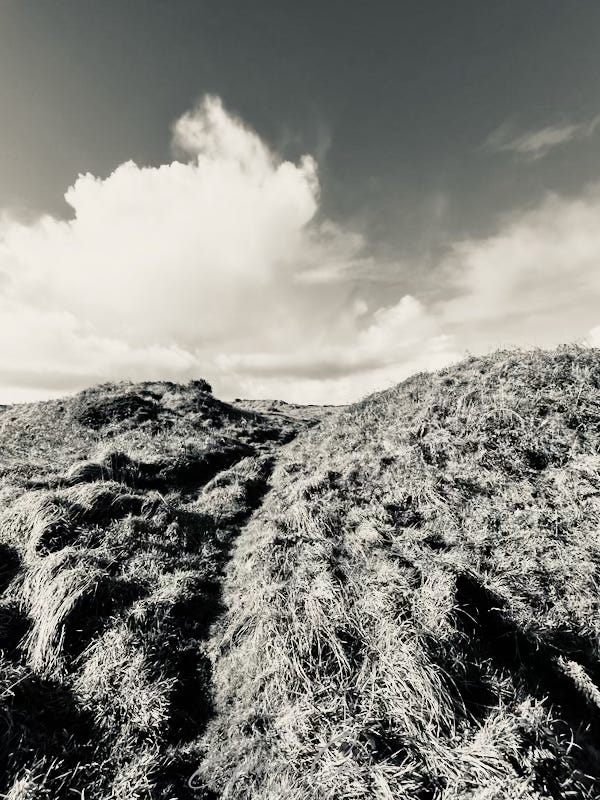
Can we link these sites to our Royal Raven? Not with anything concrete. But these brief glimpses and intangible clues left in stone and place names offer excellent fodder for the imagination2.
https://www.penzance-tc.gov.uk/coat-of-arms/
This is a revised version of my original blog post “The Royal Raven of Cornwall” http://emcox.co.uk/the-royal-raven-of-cornwall