

Thomas Hardy's Cornwall
Seeking inspiration in the Cornish landscape with the help of an English novelist and poet.

I admit, I never used to be a fan of the classics by authors like Thomas Hardy. I blame English Literature classes at school, where enjoyment of a novel came a distant second to the methodical dissecting of every scene and every character arc. Since becoming a writer, I question much of it. Does the colour of a simple, everyday object like a door have symbolic significance to the main character’s state of mind? Or did the author just pluck the colour randomly from their head? I know I have done both in my stories.
Far from the Madding Crowd
My foray into Thomas Hardy began because my parents decided to forgo retirement and become rare-breed sheep farmers. As someone who is a sucker for history (the deader the better), I decided to pick up Far from the Madding Crowd, not because of the story (I’d already watched every conceivable adaptation of the book) but to see how much of agricultural life had changed and what had stayed the same. This, I passed on to my parents, noting things like the time Gabriel took to shear a sheep in comparison to the speed at which it can be done today with electric shears. But what drew me most to Hardy’s writing as I read more of his work is his descriptions of nature and how he treats the landscape so it becomes as much a character in his novels as the human ones who inhabit it.
“If there was one class of manifestation on this matter that he thoroughly understood, it was the instincts of sheep.”
Far from Madding Crowd
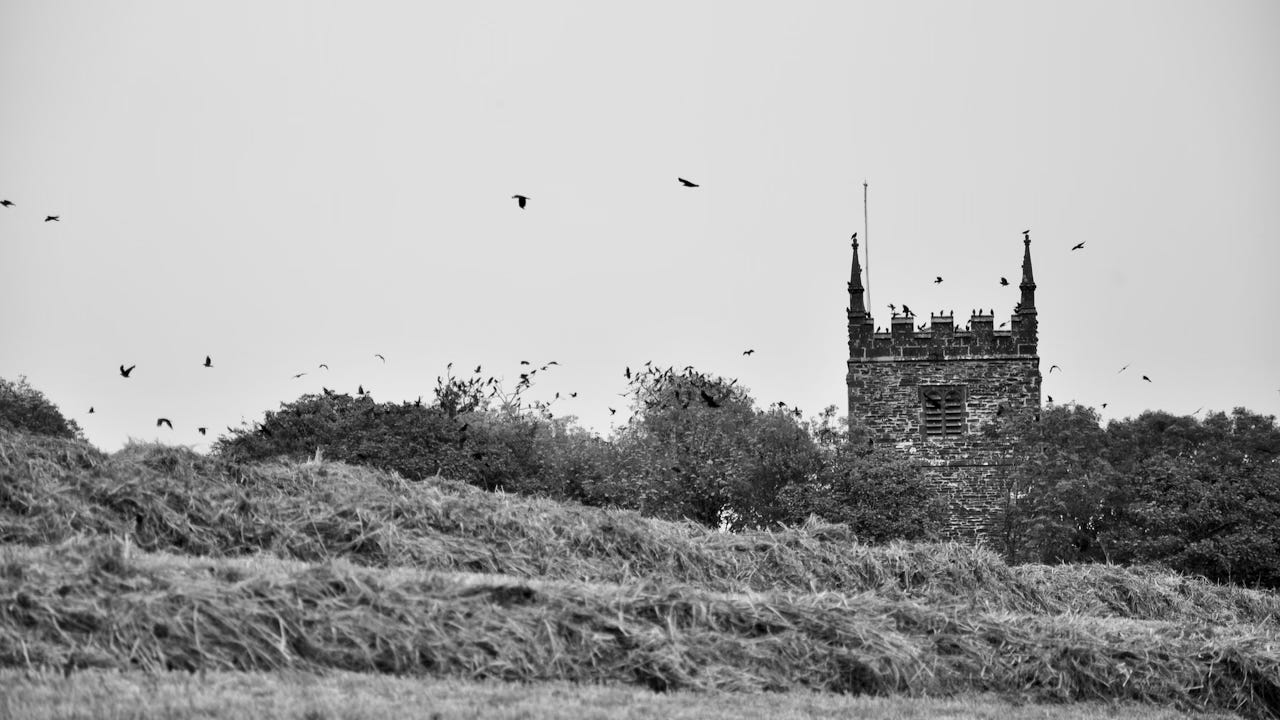
Hardy inspired me to see nature as a character within the stories I write. Although this is not an entirely novel ability for me. I see nature’s character and swings in temperament through my art and photography, and try to capture that emotional thrall the subject had upon the viewer. But I had not greatly explored this relationship in writing. The environment can reflect the nature of a character’s mood, but it can be more than that. Is it hostile or a friend? In Hardy’s Return of the Native, Egdon Heath is a place where people leave if they want to thrive.
Hardy, too, inspired me to dip into nature writing, and it is through this combination of seeking clues from the landscape for my writing that I began to notice Hardy’s roots in Cornwall.
First Love
I have been visiting Boscastle all my life. I remember the infamous flood and explored the Witchcraft Museum and harbour before walking the wooded Valency Valley. What I never realised was Thomas Hardy’s deep association with it.
A Pair of Blue Eyes is a fictional novel, yet there is an autobiographical element. Its location, Castle Boterel, is almost identical to Boscastle’s Cornish name, Kastelboterel. Hardy came here in 1870 as an architect’s assistant to arrange restoration work at St Juliot’s Church, and fell in love with Emma Gifford, who would become his first wife.
In the novel, Emma is fictionalised as Elfride Swancourt. Yet there are facets of Hardy’s character displayed in Elfride (the aspiring writer) and her two suitors: Stephen Smith (an architect) and Henry Knight (a man of letters). Hardy was torn between the two professions (something many writers can relate to). Do you follow the career which is financially viable or the one which brings the most satisfaction? Luckily, A Pair of Blue Eyes made him realise he had a chance of making a viable career as a writer.
“It contains, I suppose, your developed thoughts in embryo?’
‘Yes.’
‘If they are interesting when enlarged to the size of an article, what must they be in their concentrated form? Pure rectified spirit, above proof; before it is lowered to be fit for human consumption: “words that burn” indeed.’
‘Rather like a balloon before it is inflated: flabby, shapeless, dead. You could hardly read them.”
A Pair of Blue Eyes
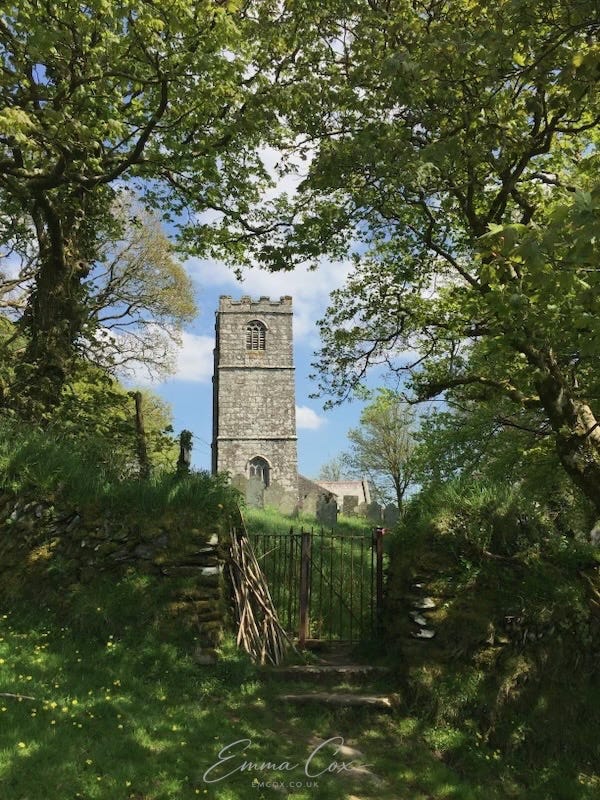
The churchyard is home to some very old Cornish crosses. It also has two memorial stones for both Hardy and Emma inside the church. Standing on the boundary and looking out over fields and woodland, it is easy to imagine you are in Hardy’s Wessex.
One element I enjoyed while reading the novel is recognising various locations. Published in 1872, it is reassuring to find familiar spots I had walked before, despite a century and a half passing.
The Man Who Died Of A Broken Heart
One weekend a few years back, my husband and I decided to leave the misty coastline and head towards Bodmin Moor to blue sunny skies, and as the country lane twisted round, we came across a horse trap being driven by a man and woman dressed in 19th-century clothing.
After the initial concern we’d travelled back in time, we came to realise we’d stumbled upon a Thomas Hardy celebration and reenactment in the small parish of St Clether. Specifically, for his poem The Face in the Casement.
Before marrying Emma Gifford, her sweetheart had been the curate’s son, Willian Serjeant. Sadly, William was dying from tuberculosis, so Emma decided to pay him one final visit.
This cosy house just by
I must call at for a minute,
A sick man lies within it
Who soon will die.
“He wished to marry me,
So I am bound, when I drive near him,
To inquire, if but to cheer him,
How he may be.”
Hardy waited outside the vicarage in his horse trap while Emma went inside to tell William she loved Hardy. When the couple left, Hardy noticed William gazing from the window and deliberately (but regrettably) put his arm around Emma in a gesture of triumph.
Then I deigned a deed of hell;
It was done before I knew it;
What devil made me do it
I cannot tell!
Yes, while he gazed above,
I put my arm about her
That he might see, nor doubt her
My plighted Love.
The pale face vanished quick,
As if blasted, from the casement,
And my shame and self-abasement
Began their prick.
The vicarage lies opposite the church, and William’s grave can be found in the churchyard. An echo of William can also be found in the pages of A Pair of Blue Eyes, when Stephen and Elfride happen to sit on the grave of a man who died of consumption. The dead man once loved Elfride, but was a lowly farmer, so not good enough for her to marry.
The Original Literary Cliffhanger
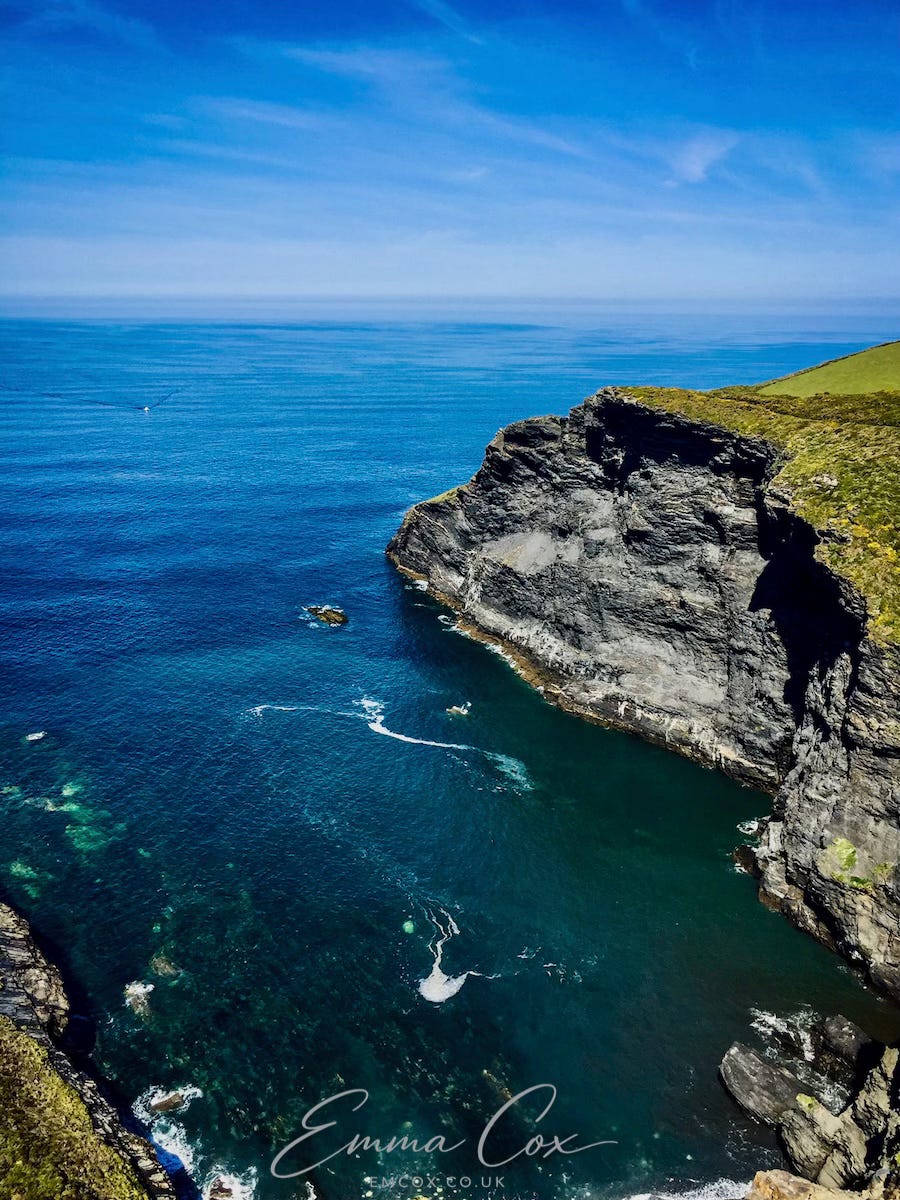
Beeny Cliff lies north along the coast from Boscastle. It is an impressively high wall of black rock ribboned by white quartz. Although the cliff remains unnamed in A Pair of Blue Eyes, it is the place where Henry Knight hangs over the edge by his fingertips. As the novel was originally serialised, this is the point where readers had to wait until the next segment to discover that Elfride Swancourt comes to his rescue. This cliffhanger is where the literary device started.
However, Beeny Cliff has a deeper hold on Hardy’s heart, for it is the title of the poem he wrote for his wife, Emma.
Hardy became estranged from Emma, who died in 1912. In response, he returned to Cornwall to revisit the places linked with their courtship and wrote Poems of 1912-1913.
O the opal and the sapphire of that wandering western sea,
And the woman riding high above with bright hair flapping free –
The woman whom I loved so, and who loyally loved me.
Beeny Cliff begins with their courtship, forty years earlier and ends in the present day.
What if still in chasmal beauty looms that wild weird western shore,
The woman now is – elsewhere – whom the ambling pony bore,
And nor knows nor cares for Beeny, and will laugh there nevermore.
Hardy is alone, and Emma is permanently lost to him. He uses the metaphor of the endless babble of the sea for time, which moves mercilessly forward without remorse for the people.
Although he married again, his heart was always with Emma. So much so, when he died in 1937, his ashes were interred in the Poets’ Corner of Westminster Abbey, but his heart was buried at Stinsford, Dorset, next to Emma.
To make the tale even more macabre, a folktale came about many years later that Hardy’s heart never made it to its intended burial site. Supposedly, a cat ran off with the heart and, depending on the tale, the box was buried empty or with a substitute animal’s heart (with thanks to the local butcher). In one retelling, the cat was caught eating it, and was killed and buried along with the slightly chewed remains of Hardy’s heart.
So, the moral is, you never realise what is on your doorstep until you look. And also, don’t leave anything lying around for a cat to find!
Really enjoyed reading this, I spent my childhood in Dorset not too far from Hardy's Cottage. It was interesting to learn more about him and his time in Cornwall.